Avoid the hype: it OK to be boring sometimes

In one of our final projects before WAO closes after a decade, we’ve been working with INASP. Our brief? To figure out how their Rising Scholars programme should be thinking about the future of its digital infrastructure.

The right tech is the tech that will just work
In one of our final projects before WAO closes after a decade, we’ve been working with INASP. Our brief? To figure out how their Rising Scholars programme should be thinking about the future of its digital infrastructure.
Rising Scholars is a community of more than 14,000 educators and researchers across Africa, Asia, and Latin America, with ambitions to support 30,000. They needed to replace an ageing, over-customised Django CMS site that only their vendor fully understood.
After understanding the Rising Scholars network, undertaking some desk research, and talking to people in the community who are part of it, we ended up recommending WordPress. In our view perhaps the most boring recommendation we could have made.
Reining ourselves in a bit
Depending who you believe, WordPress powers approximately 43% of websites. It’s been around for more than two decades at this point, there are a lot of plugins extending its functionality, and finding someone to develop and design WordPress sites is easy.
We’re advising that WordPress handles the public-facing Rising Scholars site: stories, resources, calls to action. INASP already uses Moodle for courses, so this can become the community space too – hosting discussions, member profiles, and hub activity.
While profiles of Rising Scholars network participants will be restricted to those logged-into Moodle, researchers can optionally link their public ORCID profiles. We’re not recommending a complex, bespoke framework or a novel stack that we read about on Hacker News.
This was not our default position. In fact, we did everything we could to land somewhere (anywhere!) else. We tinkered around with Wagtail, the CMS made by Torchbox, an agency we worked alongside in our recent Amnesty International UK project. We checked in on open source technologies we hadn’t thought about in years to see if maybe they were different and better now.
We explored Bonfire, the open-source federated platform with an Open Science Network ‘flavour’ that would have given Rising Scholars ORCID authentication, Zenodo integration, DOI assignment, and ActivityPub federation out of the box. We wanted to make this work, as we’ve been active in the fediverse for nearly a decade, and a research community visible across the fediverse sounds great to us. We’re all about community-owned infrastructure.
We wrote up the whole, sexy-to-funders concept. And then we recommended against it.
Using the Three Horizons model
Every person, and every organisation, has a ‘risk appetite’. It’s partly shaped by previous experience, it’s partly DNA, and it’s partly to do with the potential consequences if things went wrong. We still think Bonfire, or something like it, should be somewhere in INASP’s future for Rising Scholars. However, we wondered, is pushing all of their chips into the middle of the table and making a big gamble on it now the right thing to do?
Ultimately, we decided no. The best thing to do is to use the three horizons model and consider (1) this year, (2) the next three years up to 2030, and then (3) beyond that.
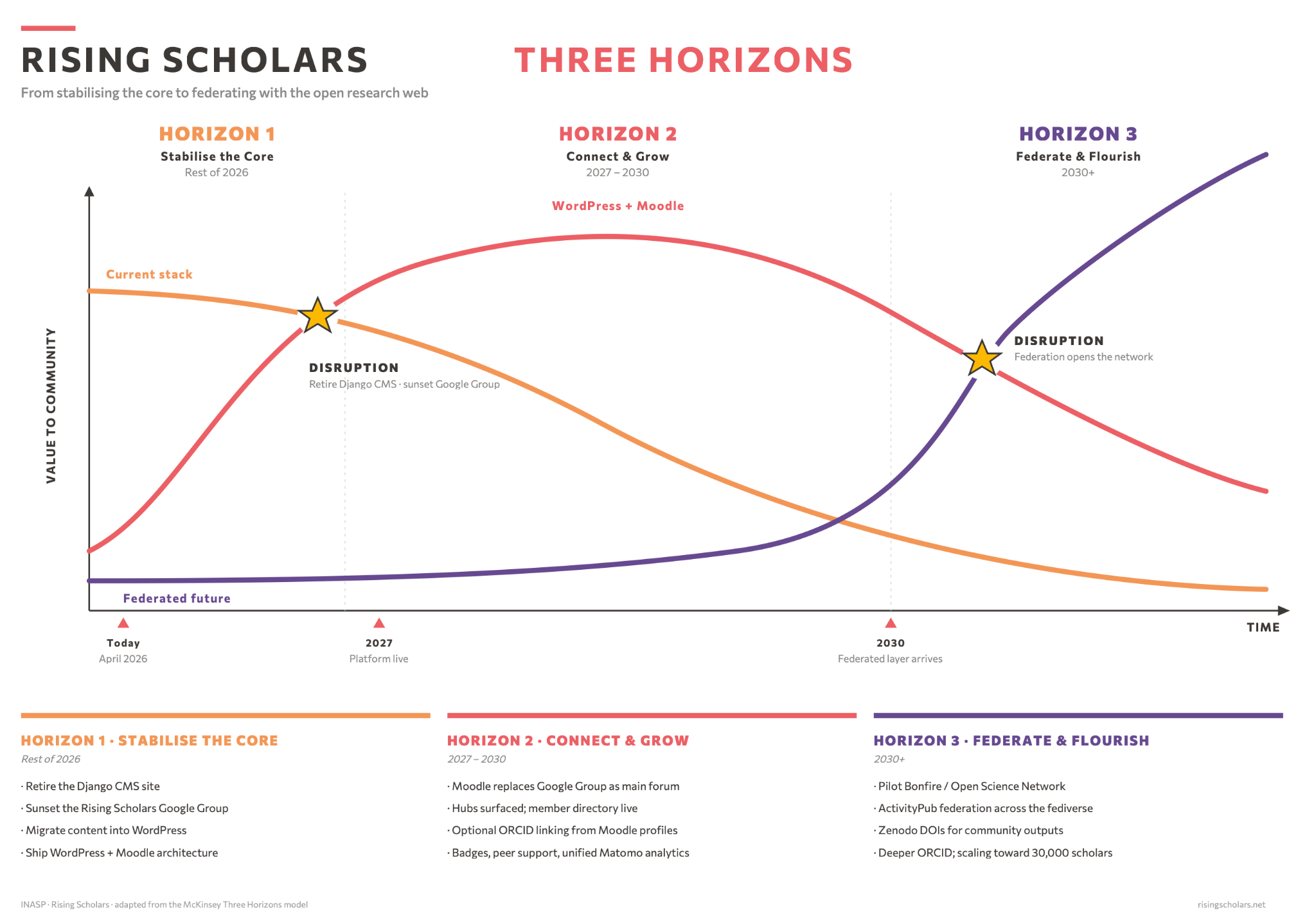
The important thing from our point of view is to avoid vendor lock-in. That’s a situation where vendors (and agencies) take advantage of an organisation’s existing budget and lock them into decisions that are too rigid. We kept coming back to the idea that charities that depend on external funding operate on a risk continuum that most of the tech sector simply ignores.
A little help, sustained over years, is worth more than a spectacular platform that lasts eighteen months.
Put your own mask on before helping others
A charity's first obligation is to the people it serves. This means building on firm ground. WordPress and Moodle are not the most glamorous options, but they give INASP options. If INASP's relationship with one implementer breaks down, they can find another. The tools are well-documented, widely hosted, and affordable to maintain. INASP already has in-house WordPress skills.
Stability makes future risk-taking possible. Once the core is solid and researchers can reliably find courses, join discussions, and connect with peers then they can experiment at the edges. They could run a Bonfire pilot for one hub, test federation with a thematic cluster, and/or try something wild with a small group who've opted in – without betting the whole community's infrastructure on it.
The boring choice isn't the final choice. Instead, it's the foundation that lets you take risks without gambling with other people's access to support.
So we chose ‘boring’
We chose WordPress and suggested INASP continue with Moodle because they're the technologies that will still be here in five years – supported by people INASP can actually hire, and running on infrastructure they can afford. We chose these platforms because the point of Rising Scholars isn't to be a technology showcase but to connect 30,000 researchers with the skills, support, and recognition they need to change their fields and their communities.
The exciting approaches and concepts are still there, written up and waiting. These can be explored once INASP has a stable foundation and their appetite for experimentation is backed by capacity. But right now, the most radical thing INASP can do is choose the technology that works, and keep working, for the people who need it most.
Discussion